What Is Technical SEO? (Direct Answer)
|
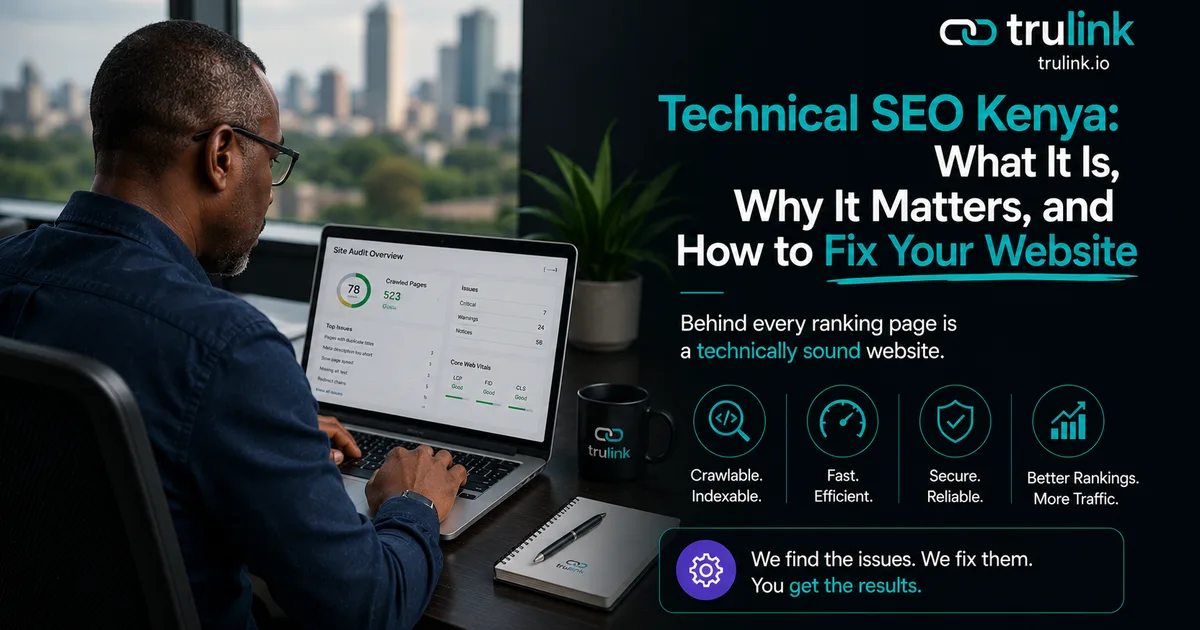
Technical SEO is the process of optimizing the infrastructure of a website so that search engines can efficiently crawl, understand, and index its pages. While content and links are visible to readers, technical SEO operates under the surface: page speed, mobile compatibility, site structure, schema markup, HTTPS security, crawl budget management, and the resolution of errors that block Google from accessing your content. Without a solid technical foundation, even excellent content will rank below its potential. |
Think of it this way. You can write the best article about tax law in Kenya, but if your website loads in 8 seconds on a Safaricom 4G connection, Google's mobile-first algorithm will penalize it regardless of content quality. You can publish 50 pages of service content, but if half of them return 404 errors or are trapped in redirect chains, Google wastes its crawl budget on broken infrastructure instead of indexing your best pages.
Technical SEO is the foundation on which every other SEO investment is built. Our complete guide to what SEO is covers the three pillars of SEO and explains why technical SEO must come first in any campaign. This article goes deep on the technical layer specifically.
Why Technical SEO Is Especially Important for Kenyan Websites
Technical SEO matters everywhere, but several Kenya-specific conditions make it particularly consequential:
Mobile-First Indexing and Kenyan Mobile Traffic
Google now uses mobile-first indexing for all websites globally, meaning Google primarily uses the mobile version of a website for ranking purposes. In Kenya, this is not a theoretical concern. Over 90% of Kenyan internet traffic originates from mobile devices in 2026, one of the highest mobile-dependency rates in the world. A website that works well on desktop but loads slowly or breaks on a Safaricom 4G connection is not just providing a poor user experience. It is actively being penalized by Google's ranking algorithm.
Slow Hosting and Shared Server Performance
Most Kenyan small business websites are hosted on affordable shared hosting plans. Shared hosting means your website shares server resources with potentially hundreds of other websites on the same physical server. When those other websites experience traffic spikes, your site slows down. Slow hosting is one of the most common causes of poor Core Web Vitals scores on Kenyan websites, and Core Web Vitals are a confirmed Google ranking factor.
Legacy Websites Built Without SEO Consideration
A significant proportion of Kenyan business websites were built several years ago by web designers who were optimizing for appearance rather than search engine compatibility. These sites commonly have bloated code, uncompressed images, no schema markup, poor heading hierarchy, and URL structures that confuse Google's crawlers. A website redesign that incorporates technical SEO from the ground up typically produces faster ranking improvements than applying SEO to a technically weak legacy website.
The Nairobi Context: Why Technical SEO Is a First-Mover Opportunity
In Nairobi specifically, the technical SEO gap represents a significant competitive opportunity. Most businesses in Westlands, Kilimani, Karen, and the CBD have websites, but very few have had those websites properly audited for technical issues. A Nairobi business that resolves its Core Web Vitals failures, implements schema markup, and cleans up its redirect errors before its competitors do will hold a technical advantage that is difficult to displace once rankings are established. The same principle applies across secondary Kenyan cities. A business in Kisumu, Nakuru, or Eldoret that launches with a technically clean website faces even lower competition and can establish Page 1 rankings significantly faster than a Nairobi-based competitor. Our local SEO Nairobi guide covers the competitive landscape by neighborhood in detail.
The African and Global Context
Technical SEO issues are not unique to Kenya. Across Nigeria, Ghana, South Africa, Tanzania, and Uganda, the majority of business websites were built without structured technical SEO consideration. For international brands entering African markets, a technically optimized website is one of the fastest ways to establish organic visibility before local competitors catch up. Trulink.io's experience spans both Kenyan and African market SEO and global client engagements through Upwork, giving us direct comparative insight into where African websites typically fall short against international benchmarks.
The Mutea Law Baseline as a Real Example
|
Real example: Technical issues found at the start of the Mutea Law engagement Ahrefs Health Score at baseline: 68 out of 100 — indicating multiple technical issues present Redirect chains: 68 internal redirects identified in the site crawl Broken links: 4 broken pages (404 errors) identified Crawled but not indexed: 2 pages visible to Google but excluded from the index Redirect error: 1 page returning a redirect error in Google Search Console Result: These issues were identified and documented before content work began. Resolving them was part of the technical foundation that enabled 1,391% impressions growth in 26 days. Read the full case study |
The 8 Elements of Technical SEO Every Kenyan Website Needs
1. Crawlability and Indexation
Before Google can rank your website, it must be able to find and read it. Google uses automated programs called crawlers (or spiders) to discover web pages by following links. If your pages are blocked by a misconfigured robots.txt file, buried behind login walls, or excluded from your sitemap, Google cannot index them and they will never rank.
How to check: Use Google Search Console (free) to inspect individual URLs and see whether Google has indexed them, and if not, why. The URL Inspection tool will tell you directly if a page is indexed, excluded, or has a crawl error.
|
Common crawlability issue |
What it means |
How to fix it |
|
Page blocked by robots.txt |
Google instructed not to crawl the page |
Review robots.txt and remove incorrect Disallow rules |
|
noindex tag on the page |
Google told not to add page to the index |
Remove or correct the noindex meta tag |
|
Page not in sitemap |
Google may not discover the page at all |
Add the page to your XML sitemap and resubmit |
|
Orphan page (no internal links) |
No links pointing to the page from your site |
Add internal links from relevant existing pages |
|
Crawled but not indexed |
Google sees the page but excludes it |
Improve content depth and remove thin or duplicate content |
2. Page Speed and Core Web Vitals
Page speed is a confirmed Google ranking factor and one of the most impactful technical issues on Kenyan websites. Core Web Vitals are Google's specific set of page experience metrics:
- LCP (Largest Contentful Paint): how long the main content of a page takes to load. Google's threshold is under 2.5 seconds. Many Kenyan websites score 5 to 8 seconds.
- INP (Interaction to Next Paint): how quickly a page responds to user interaction. Poor scores indicate heavy JavaScript blocking the page.
- CLS (Cumulative Layout Shift): whether page elements move around as the page loads. Particularly problematic on mobile when images load without dimensions set.
Test your website now: go to pagespeed.web.dev and enter your URL. Run the test on both mobile and desktop. Focus on the mobile score — given that over 90% of Kenyan traffic is mobile, a poor mobile score is actively costing you rankings.
|
The most common causes of slow Kenyan websites: Uncompressed images (often the single biggest improvement available), too many external scripts loading on every page, unminified CSS and JavaScript files, slow shared hosting, no content delivery network (CDN), render-blocking resources preventing the page from displaying while scripts load. |
3. Mobile Optimization
Mobile optimization means more than a website that technically displays on a phone screen. Google's mobile-first indexing means the mobile version of your site is the primary version Google evaluates. Check for these on mobile specifically:
- Text is readable without zooming on a standard smartphone screen
- Buttons and links are large enough to tap accurately without misclicking
- Content is not wider than the screen, requiring horizontal scrolling
- Forms are functional and the keyboard does not obscure the input fields
- Page loads in under 3 seconds on a standard 4G mobile connection
4. HTTPS and Site Security
Google gives a ranking preference to HTTPS-secured websites over unsecured HTTP ones. In 2026, this is not a competitive advantage but a baseline requirement. If your Kenyan business website still loads on HTTP rather than HTTPS, you are signaling to both Google and your visitors that your site is insecure. Most Kenyan web hosts provide free SSL certificates through Let's Encrypt. Contact your hosting provider if your site is not yet on HTTPS.
5. Site Architecture and URL Structure
Your website's architecture determines how easily Google can navigate from your homepage to every other page on your site. A well-structured site has a clear hierarchy: homepage leads to category pages, category pages lead to individual service or article pages. No important page should be more than three clicks from the homepage.
- URLs should be short, descriptive, and contain the target keyword: trulink.io/blog/technical-seo-kenya is correct. trulink.io/?p=147 is not.
- Avoid URL parameters where possible on content pages, as they create duplicate content issues
- Use lowercase letters and hyphens to separate words in URLs. Never use underscores or spaces.
- Ensure each URL is unique and permanent. Changing URLs breaks links and loses accumulated ranking signals unless properly redirected.
6. Redirect Management
Redirects are necessary when a URL changes, but poorly managed redirects create significant technical SEO problems. The most common issues on Kenyan websites:
- Multiple sequential redirects (A redirects to B, B redirects to C). Each redirect in a chain loses approximately 10 to 15% of the link equity being passed. Google also stops following chains after a certain length.: Redirect chains
- A redirects to B, B redirects back to A. These completely block crawlers and make affected pages unrankable.: Redirect loops
- A 302 redirect tells Google the move is temporary. A 301 tells Google the move is permanent and passes full link equity. Most URL changes on Kenyan websites should use 301 redirects.: 302 instead of 301 redirects
- When a page is deleted without a redirect, it becomes a 404 error page that wastes crawl budget and breaks any links pointing to it.: Missing redirects after page deletion
7. Schema Markup and Structured Data
Schema markup is code added to your web pages that tells Google and AI tools precisely what your content contains. It is one of the most underused technical SEO elements on Kenyan websites, and one of the most impactful for both traditional search rankings and AEO (AI search citations).
|
Schema type |
What it tells Google |
Best for |
|
LocalBusiness |
Your business name, address, phone, hours, service area |
Every Kenyan business website |
|
Article |
That a page is an article, its author, publication date, and topic |
Every blog post and guide |
|
FAQPage |
The specific questions your content answers and the precise answers |
FAQ sections on any page |
|
Organization |
Your business name, logo, social profiles, and contact details |
Homepage and about page |
|
BreadcrumbList |
The navigation path from homepage to the current page |
All interior pages |
|
Review / AggregateRating |
Client review data and overall rating |
Service pages with testimonials |
FAQPage schema is particularly important for both AEO and GEO. When your FAQ sections are marked up with structured data, AI tools can extract the precise questions and answers and cite them directly in AI-generated responses. Schema markup also strengthens your entity signals, which is a core GEO mechanism for getting your brand recommended by name in AI-generated answers. This is one of the primary technical mechanisms behind the AI citations and brand recommendations we have achieved for clients. For the full picture, read our guide on what AEO and GEO are and our breakdown of how to get cited by Google AI Overviews.
8. XML Sitemap and Robots.txt
Your XML sitemap is a file that lists all the pages on your website that you want Google to crawl and index. Without a sitemap, Google must discover your pages by following links, which is slower and less reliable, particularly for newer pages. After publishing any new article or page, submit the URL for indexing through Google Search Console and ensure the page is included in your sitemap.
Your robots.txt file tells Google which parts of your site to crawl and which to ignore. A correctly configured robots.txt prevents Google from wasting crawl budget on admin pages, login areas, and duplicate content. An incorrectly configured one can accidentally block Google from your entire site. Check yours at yourdomain.com/robots.txt.
How to Run a Basic Technical SEO Audit on Your Kenyan Website
You do not need expensive tools to identify the most critical technical issues affecting your website. This five-step audit uses free tools:
- Search site:yourdomain.com in Google. The number of results tells you how many of your pages are indexed. If the number is significantly lower than the pages you have published, you have an indexation problem.: Check your indexation status
- Go to pagespeed.web.dev and test your homepage on mobile. Note your LCP score specifically. Anything above 4 seconds is a significant drag on rankings for Kenyan mobile searchers.: Run a Core Web Vitals test
- In Google Search Console, open the Indexing section and review the Coverage report. Look for pages with errors, pages marked as crawled but not indexed, and pages excluded by noindex tags. Each category tells you a different technical story.: Check your GSC Coverage report
- The free version of Screaming Frog SEO Spider crawls up to 500 URLs. Run it on your site and filter for 404 errors and redirect chains. Every 404 page and every redirect chain is a technical issue you can fix.: Crawl your site for broken links
- Go to search.google.com/test/rich-results and enter your URL. This tool tells you which schema types Google detects on your page and whether there are any errors in your structured data implementation.: Check your schema markup
Technical SEO: Key Facts and Statistics
|
Statistic |
Figure |
Source |
|
Kenyan internet traffic from mobile devices |
Over 90% |
YuDigify / 2026 market data |
|
Google's LCP threshold for a good page experience |
Under 2.5 seconds |
Google Search Central |
|
Pages with poor Core Web Vitals penalized in rankings |
Confirmed ranking factor |
Google Search Central |
|
Average time for fixed technical issues to reflect in rankings |
2 to 4 weeks |
Ahrefs technical SEO research |
|
Percentage of websites with at least one crawl error |
More than 70% |
Ahrefs site audit research |
|
Redirect chains reduce link equity passed by approximately |
10 to 15% per hop |
SEO industry consensus |
|
Google index coverage rate for sites with submitted sitemaps |
Significantly higher |
Google Search Central |
|
Ahrefs Health Score of Mutea Law site at campaign start |
68 out of 100 |
Trulink.io client data, Ahrefs |
Technical SEO Red Flags on Kenyan Websites: What to Look For
|
Warning signs your website has unresolved technical SEO issues Your mobile Core Web Vitals score is below 50: This is directly affecting your Google rankings for mobile searches, which represent over 90% of Kenyan queries. Multiple URLs lead to the same content: Duplicate content confuses Google about which version to rank and splits link equity across multiple URLs instead of concentrating it on one. Your site loads HTTP instead of HTTPS: Google Chrome marks HTTP sites as 'Not Secure.' This reduces user trust and carries a direct rankings penalty. GSC shows 'crawled but not indexed' for important pages: Google is visiting these pages but deciding not to include them in search results, usually because of thin content or technical quality signals. Your site has no XML sitemap: Google must discover all your pages by following links, which is slower and misses pages with few or no internal links. No schema markup anywhere on the site: You are missing both rich result eligibility in traditional search and a primary AEO signal for AI search citations. |
How Trulink.io Approaches Technical SEO
Every Trulink.io engagement begins with a technical audit before any content is published. This sequence is deliberate. Publishing content onto a technically broken website produces significantly slower results than publishing onto a clean, well-structured foundation. The Mutea Law engagement documented above demonstrates what is possible when technical issues are identified and resolved as a first step before the content engine begins.
- We crawl your website using professional tools, identify every crawl error, redirect issue, indexation problem, and Core Web Vitals failure, and prioritize them by ranking impact: Technical audit in Month 1
- We implement LocalBusiness, Article, FAQPage, Organization, and BreadcrumbList schema as standard on every client website, covering both traditional search and AEO eligibility: Schema markup implementation
- We identify the specific elements causing slow mobile load times and coordinate or implement fixes, with pagespeed.web.dev scores tracked before and after: Mobile and speed optimization
- We verify your sitemap is complete and accurate, submit it to GSC, and review your robots.txt for accidental crawl blocks: Sitemap and robots.txt review
- We check GSC coverage, performance, and manual action reports on a weekly basis and address new technical issues as they arise: Ongoing GSC monitoring
- We identify redirect chains, 404 errors, and URL inconsistencies and produce a structured fix list with implementation instructions: URL and redirect audit
|
For global clients and international businesses: Trulink.io delivers technical SEO audits and implementation for international clients through Upwork, where we are Top-Rated with a 100% Job Success Score and 200+ completed projects. International brands entering African markets, e-commerce businesses with multi-region sites, and agencies needing technical SEO white-labeling are among the global clients we serve. A technically clean website is universally valuable regardless of the market it targets. |
For details on what a full SEO, AEO, and GEO engagement with Trulink.io covers, visit our SEO, AEO and GEO services page. For context on what technical SEO costs alongside other services, see our transparent digital marketing pricing guide. To understand what comes after the technical foundation is set, read our guide to how long SEO takes in Kenya.
|
Get a Free Technical SEO Audit for Your Kenyan Website Trulink.io delivers technical SEO audits for Kenyan and Nairobi businesses, African brands expanding across the continent, and international clients globally via Upwork (Top-Rated, 100% JSS, 200+ projects). A clean technical foundation is the prerequisite for SEO, AEO, and GEO. We identify your crawl errors, Core Web Vitals failures, schema gaps, and redirect problems, and give you a prioritized fix list. No obligation. Visit trulink.io | WhatsApp +254 720 744 244 | support@trulink.io |
Frequently Asked Questions About Technical SEO in Kenya
What is the difference between technical SEO and on-page SEO?
Technical SEO covers the infrastructure of a website: speed, crawlability, indexation, schema markup, redirects, and mobile compatibility. On-page SEO covers the visible content of a page: keyword targeting, headings, meta titles, descriptions, and internal links. Both are required for strong rankings. Our guide to what SEO is explains how technical SEO fits within the broader three-pillar SEO framework.
How do I check if my Kenyan website has technical SEO problems?
Start with Google Search Console (free). Check the Coverage report for crawl errors and indexation issues. Run your homepage through PageSpeed Insights to see your Core Web Vitals scores on mobile and desktop. Search site:yourdomain.com in Google to check how many of your pages are indexed. These three checks will surface the most impactful issues on most Kenyan websites.
Does page speed really affect Google rankings in Kenya?
Yes, directly. Core Web Vitals, which include page speed metrics, are a confirmed Google ranking factor. In the Kenyan context, where over 90% of internet traffic is mobile, a slow mobile experience carries a more severe ranking penalty than the same issue would in a desktop-heavy market. Google's mobile-first indexing means your mobile performance is your primary ranking signal, not your desktop performance.
How long does it take for technical SEO fixes to improve rankings?
Technical fixes typically reflect in Google rankings within 2 to 4 weeks after Googlebot recrawls the affected pages. You can speed up recrawling by requesting indexing of fixed pages through Google Search Console immediately after making changes. More significant improvements, such as resolving widespread crawl budget issues or implementing schema markup across an entire site, may take 4 to 8 weeks to fully reflect in rankings. Our guide to SEO timelines in Kenya covers the full ranking timeline in context.
Is schema markup necessary for small Kenyan businesses?
Yes, particularly LocalBusiness and FAQPage schema. LocalBusiness schema is essential for appearing correctly in Google Maps and local search results and for feeding accurate business data to AI tools when they generate local business recommendations. FAQPage schema enables rich result eligibility and is one of the primary technical signals for AEO. For more on how schema connects to AI search citations, read our AEO guide.
Can I do technical SEO myself or do I need an agency?
Many technical SEO tasks can be done independently using free tools: submitting your sitemap to Google Search Console, fixing broken links, setting up HTTPS, and compressing images are all DIY-friendly. Schema markup requires more technical knowledge but is implementable with plugins on most CMS platforms. For a comprehensive technical audit, redirect management, and full schema implementation across a website, working with a specialist typically produces faster and more thorough results. Contact Trulink.io for a free technical audit. International clients can also find us on Upwork where we are Top-Rated with a 100% Job Success Score.
Does technical SEO affect AEO and AI search citations?
Significantly. AI tools like ChatGPT, Perplexity, and Google AI Overviews cannot cite pages they cannot access. A page blocked by robots.txt, excluded from the index, or returning a crawl error will never be cited by an AI tool regardless of content quality. Schema markup, particularly FAQPage and Article schema, directly signals to AI crawlers what questions your content answers. Proper technical SEO is the prerequisite for AEO. Read our AEO vs SEO comparison and our Google AI Overviews guide for the full picture.
Trulink.io — Kenya's SEO, AEO and GEO Digital Marketing Agency | trulink.io | +254 720 744 244 | support@trulink.io