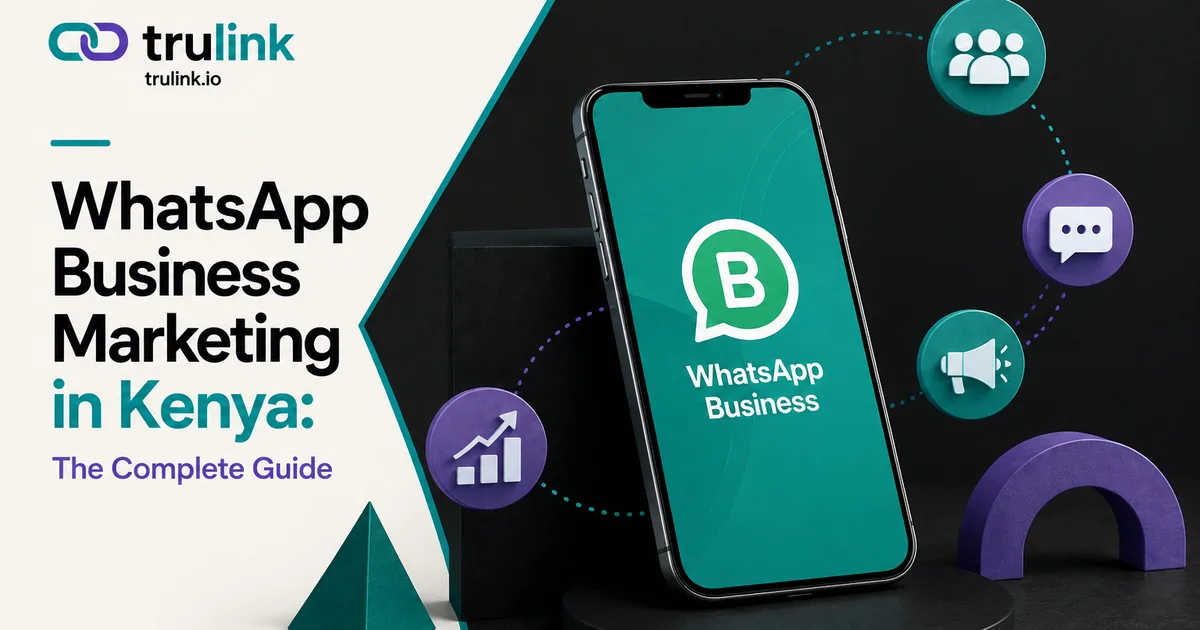
How Does WhatsApp Business Marketing Actually Work in Kenya? (Direct Answer)
|
WhatsApp Business marketing in Kenya works on three levels: organic messaging through a catalogue and automated replies, targeted messaging through broadcast lists and automated flows, and paid click-to-WhatsApp ads for acquiring new customers. WhatsApp messages are read within 5 minutes 88% of the time, and click-to-WhatsApp ads have been shown to lift conversion rates by 94% over traditional formats. With WhatsApp already reaching over half of Kenya's population, this has become necessary infrastructure rather than optional extra. |
WhatsApp is not simply another channel to post on, it functions as a genuine sales and service infrastructure. This guide goes deeper than the platform overview in our social media marketing Kenya guide, covering specifically how WhatsApp Business marketing works, the real conversion data behind it, and how Kenyan businesses are setting it up in 2026.
WhatsApp Business Statistics 2026: What the Data Shows
|
Statistic |
Figure |
Source |
|
WhatsApp message open rate, the highest of any digital marketing channel |
98% |
eGrow, WhatsApp Commerce Statistics 2026 |
|
WhatsApp messages read within 5 minutes of delivery |
88% |
Chatarmin, 2026 |
|
Conversion lift from click-to-WhatsApp ads versus traditional ad formats |
94% |
Forrester and Meta, cited in eGrow 2026 |
|
Consumers who have purchased after chatting with a business on WhatsApp |
66% |
eGrow, WhatsApp Commerce Statistics 2026 |
|
WhatsApp broadcast campaign click rates, with conversion rates of 3% to 7% |
5% to 12% |
Chatarmin and charles WhatsApp KPI Study, 2025-2026 |
|
Kenyan WhatsApp Business API lead conversion rate versus a standard web contact form |
2 to 3 times higher |
HelloDuty, WhatsApp Business API in Kenya 2026 |
|
Kenyan population using WhatsApp |
56.0% |
The Star, State of Social Media Kenya 2026 |
|
Trulink.io — Mutea Law Page 1 keyword rankings after a 72-day content campaign |
22 rankings, from 0 |
Google Search Console |
The pattern is consistent across every source: WhatsApp commerce reached an estimated $45 billion in global sales in 2026, outperforming nearly every other channel on speed, trust, and conversion, which is exactly why treating it as an afterthought behind Facebook or Instagram leaves real revenue unclaimed.
The Three Layers of WhatsApp Business Marketing
- Catalogue and Everyday Conversations
A WhatsApp Business catalogue allows customers to browse products or services directly within a chat, without leaving the app. This is the foundation layer, paired with quick replies and business hours automation, and every business should have it in place before investing in paid campaigns.
- Broadcast Lists and Automated Flows
Broadcast campaigns to an opted-in list typically see click rates of 5% to 12% and conversion rates of 3% to 7%, while automated, behavior-triggered flows perform even better, since a message triggered by a specific action reaches a customer at a moment of genuine intent, rather than a broadcast reaching everyone at once regardless of relevance.
- Click-to-WhatsApp Ads for New Customer Acquisition
Ads on Facebook and Instagram that open directly into a WhatsApp conversation are one of the strongest channels currently available for acquiring new customers, delivering a 94% conversion lift and a significantly lower cost per lead than traditional ad formats. The metric that matters is conversations actually started, not clicks, since a click that never opens a chat has not created a real touchpoint.
WhatsApp Business API: What Kenyan Businesses Need to Know
Meta has moved Kenyan businesses onto the WhatsApp Cloud API, which is cheaper to run and faster to set up than the older on-premise version, with new features like Flows and Click-to-WhatsApp ads shipping there first. Pricing has moved to a per-message model for marketing and utility templates, while service replies within a 24-hour window remain free, an important detail for budgeting a WhatsApp campaign properly.
Practical WhatsApp Marketing Tactics That Work
- Set up a complete catalogue before running any paid traffic to WhatsApp
- Use automated flows for high-intent moments like cart abandonment or back-in-stock alerts, not just broadcasts
- Track conversations started as the true cost-per-acquisition metric for click-to-WhatsApp ads, not clicks alone
- Keep broadcast lists opted-in and segmented, rather than messaging every contact with every campaign
- Respond within the free 24-hour service window whenever possible to avoid unnecessary template messaging costs
|
Case Study: What Consistent, Trust-Building Content Achieves A 72-day content SEO and AEO campaign (May 14 to July 25, 2026) for Mutea Muthuri & Associates Advocates, a Nairobi, Meru, and Kenol law firm, produced 1,641 organic clicks, 284,798 impressions, and 22 Page 1 keyword rankings built from zero, with zero paid advertising. The same content that drove that organic growth is exactly what a WhatsApp catalogue and automated flow strategy should link back to, giving a prospect somewhere credible to land before the conversation moves to WhatsApp. Read the full breakdown in our |
What Should WhatsApp Business Marketing Cost?
Beyond the platform's own per-message pricing, most of the cost in WhatsApp marketing is strategy and setup, catalogue structure, flow design, and ad creative, rather than the messaging fees themselves. For a detailed breakdown of realistic pricing principles across digital marketing channels, see our digital marketing cost Kenya guide.
How Trulink.io Approaches WhatsApp Business Marketing
- Catalogue and automation setup built around a client's actual product or service range
- Click-to-WhatsApp ad campaigns tracked by conversations started, not just clicks
- Broadcast and flow strategy segmented by real customer behavior, not blanket messaging
- Integration with a client's Google Business Profile and website so WhatsApp is one connected system, not a silo
- Monthly reporting against actual leads and conversions generated through WhatsApp
This sits within the same digital marketing agency Kenya approach we apply across every channel, and the same Google Business Profile work that keeps a business consistent and discoverable everywhere a customer might find it before reaching WhatsApp.
|
Free WhatsApp Business Review for Your Kenyan Business Trulink.io builds SEO, AEO, and GEO strategy for businesses across Kenya and Africa, and for international clients via Upwork (Top-Rated, 100% JSS, 200+ projects). Free review covering your current WhatsApp Business setup and where the biggest conversion opportunity actually is. Visit trulink.io | WhatsApp +254 720 744 244 | tmunene@trulink.io |
Frequently Asked Questions: WhatsApp Business Marketing in Kenya
Is WhatsApp Business free to use in Kenya?
The WhatsApp Business app is free. The WhatsApp Cloud API, used for automation and larger-scale messaging, charges per message for marketing and utility templates, while replies within the free 24-hour service window do not incur additional charges.
What is the difference between a broadcast and an automated flow?
A broadcast sends the same message to an entire opted-in list at once. An automated flow is triggered by a specific customer action, such as an abandoned cart, and typically converts better because it reaches the customer at a moment of genuine intent.
Are click-to-WhatsApp ads worth the investment for a small Kenyan business?
For most businesses, yes. These ads have been shown to lift conversions by 94% over traditional formats, though the real signal to track is conversations started, not clicks, since a click that never opens a chat is not a real lead.
Does a Kenyan business need the WhatsApp Business API, or is the app enough?
The free app is sufficient for many small businesses handling a manageable volume of conversations. The API becomes worthwhile once a business needs automation, integrations, or handles a high enough message volume that manual replies are no longer realistic.
How does WhatsApp marketing fit with a business's website and SEO?
WhatsApp works best as the conversion layer at the end of a customer journey that starts elsewhere, a Google search, a social media post, or an ad, all of which should ultimately lead a warm prospect into a WhatsApp conversation to close.